

Connect


Thursday, 1 December 2016

Tch!—Malls!


METROPOLIS at metrotown

Procrastination sucks. And so do malls. You know what also sucks? Long posts, which is what this is going to be :(

Crappy Lazy opening aside, I've been wanting to opine about malls for a while now... like two three months ago. But slacking off holding it off gave me time to think about what significance malls have, and why I visit them at all. Hell, I've changed the title of this post a few times.

So what are malls, anyway?
They're enormous (sometimes but not always) multilevel complexes housing hundreds of shops within. There's a mandatory food court; maybe a movie theatre; a few sit-in chain restaurants; an anchor department store or two; an off-price department store; many levels of poorly ventilated concrete and insulation-packed subterranean parking labyrinths shadowing the mall—and we can't forget the street level parking lots, which is just the best use of Vancouver's already-scarce real estate.


METROPOLIS at Metrotown.

Malls are a congregation of consumption; a hub of weekend social activity. They're a place to hang out with family or friends, grab a bite to eat, go shopping, or entertain our ever-decreasing attention spans. Malls create jobs, drive local economies, and impact communities. Their sheer size enables them to employ thousands of people in a variety of jobs from all demographics... but more important than that, however, in order for malls to sustain said employment, they need customers—customers who are willing to spend and not "just browse", and regular (and sometimes heavy) discount cycles don't help.

Why go?
Generally, when I go to a mall I'm a "browser" (I know...) because (sub)consciously I want to find something worth impulse buying (I suggest against doing that).


Left: my latest acquisition from my exploration of Tsawwassen Mills; right: only pair available but not in my size... otherwise I'd have bought both. They were as close to perfect as I could ask for in a trainer—discreet with no visible branding, luxurious leather/suede and sporty nylon construction, and sooo cushy and comfortable. This is a prime example of an off-price retailer getting it right: 85.5% off (MSRP CAD$345)!

I also love shopping... so there's that. But as the title suggests, malls have lost their luster and for a while now, but I've been aimlessly walking through them because they are everywhere. When I grocery shop I intuitively wander the mall before I even remember that my destination was the supermarket. They are a mere minutes' walk from where I work, and Vancouver's public transit is convenient enough that any direction I take will eventually take me by a mall; at this point I go because they're just there. I don't want to use the word "jaded"... Bored? Desensitised? Disinterested? By and to whatever attraction there is to want to go to a mall.

Contrary to what my feelings are toward malls, literature argues both that malls are dying or thriving (in Canada, too), depending on who you ask. Regardless of viewpoint, there is a universal consensus that malls will make a comeback or are already in the process of adjusting to new consumer behaviours and changing expectations, like focusing on experience rather than just transactional exchanges. And that's the point. As they are now malls are about exchanging money for goods, with a bit of customer service thrown in. I walk around, visit my usual suspects, sift through their wares, and may or may not buy something. That's no experience, I'm just a retail zombie. Certain brands are releasing new styles almost weekly just to try and keep customer interest.

Dubai Mall Aquarium

Some "malls" are in a league of their own. Internationally renowned luxury shopping centres like South Coast Plaza in Orange County California (who doesn't even want to be associated with the word "mall"), the Dubai Mall, or the Galleria Vittorio Emanuele II in the heart of Milan cater to the wealthy and the aspirational alike. Whether it's the unparalleled international services of South Coast Plaza, the massive aquarium and underwater zoo in the Dubai Mall, or the beautifully rich historical site of the Galleria, these shopping landmarks give patrons an experience worth coming back for on top of offering world class brands.

Vancouver
While Vancouver isn't lacking its fair share of luxury labels, stores are standalone boutiques al fresco on busy streets rather than enclosed in a mall setting. Downtown alone is home to many haute brands: Hermés stands facing Tiffany & Co. at Alberni/Burrard; across from them are Louis Vuitton, Dior, and Gucci boutiques nestled in the Fairmont Vancouver Hotel on Georgia/Burrard; one city block away on Alberni/Thurlow is an fashionista's dream: Prada, Saint Laurent Paris, Moncler, Versace, Brunello Cucinelli, and Burberry all within a 20-second stroll from one another; and alone on Robson is Salvatore Ferragamo. There are boutique purveyors of many upscale labels, too, like Leone anchoring Sinclair Centre, and for the younger crowd Boys'Co. on Robson, and Haven and Neighbour in hip and trendy Gastown.

Consistently recognised as one of the best cities in the world and the gateway to the Pacific, one would think Vancouver would have a luxury shopping centre catered toward vacationing well-to-doers and jet-setting business people. But I suppose standalone boutiques have one advantage—no crowds. There was potential in the Oakridge Centre community redevelopment, though it's too early to say what might've become of its retail profile. Original plans have been effectively scrapped, unfortunately, for being too ambitious. Whether this means a scaling down of plans or a complete redo from scratch remains to be seen. Either way, the scale of the original development was something to behold.

Pacific Centre
Although my mall experiences are largely Vancouver-based, I don't imagine it being too different around the world*. They tend to have similar store directories, only configured differently. Some brands are ubiquitous and far-reaching, and can be found almost anywhere:
  • the GAP family of stores
  • fast fashion merchants H&M, ZARA, Forever21, and Uniqlo
  • the Abercrombie and Hollister duo (and, similarly, American Eagle)
  • a Guess?
  • high street Topshop/Topman
  • a few Luxottica representatives
  • ALDO
  • Nike
  • Coach and Michael Kors somewhere
  • Apple store
  • variety of kiosks
  • ... and many others
* "westernised" vs localised malls where brands are, well, localised.

My point is there is a level of homogeneity that sparks little, if any, interest beyond the initial visit that can leave a feeling of longing to return on a regular basis. I suppose one major reason anyone would shop at a brick and mortar—mall or otherwise—is to physically handle, touch, try and compare the products they're interested in buying. Shoppers may want customer service, or expertise a salesperson possesses. There's always the immediate gratification of acquiring the product now rather than waiting x-days for shipping. Some people love the superficial carrying of the shopping bag from their favourite store. The act of going shopping can be social. Some people make a day of it and plan ahead of time: shopping lists, specific outfits, what shops to visit, budget (ha ha) and contingency funds for those pesky impulses, and whatever personal reason one can think of. I, on the other hand, am a solo shopper through and through, so my reasons are few and selfish.


Tsawwassen Mills
I recently visited the newly opened Tsawwassen Mills which was welcomed with much fanfare—so much so that the parking lot was a nightmare to navigate due to congestion (I transited). Needless to say, the mall was packed like canned sardines. Attendance will eventually settle down to a level of normalcy (which it has), but the initial number of visitors was exaggerated since opening week also happened to be a long weekend. Remember that street-level parking I detest?


Disgusting (don't mind the ghost Camry), and this isn't the entire parking lot! The entire shopping centre is literally surrounded by giant plots of land reserved strictly for parking. Honestly, these parking lots only serve sale season. Outside of that they are, by my estimate, 50-60 percent empty.

Tsawwassen Mills is a combination of regular-priced stores and off-price outlet stores, which means the former will often push sales promotions just to compete with the latter—amazing for shoppers and bargain hunters. I didn't get a chance to fully explore the entire mall, but based on my quick assessment the stores I'd like to visit more in-depth are the Harry Rosen outlet and Saks Off Fifth (which was closed from the outside and stanchioned off on the inside for crowd control. The line stretched far enough, so no way I was going). The two off-price Winners and Marshalls are a given—I love off-priced retailers. There are worthy finds if one knows where to look and what to look for. I passed by at least two art galleries, one of them—Ian Tan Projects—prominently featured near one of the Mills' six grand entrances. There is a lingering novelty, so I plan on returning.


Park Royal South, which has SIMONS! It's the only reason I go to Park Royal.

Other Reasons...
I don't like malls—or most brick and mortars in general—for a more personal reason: I'm a shitty customer. Just the absolute worst. Don't talk to me! Leave me alone! Stay away from me! I don't want your help! See the earbuds!? Disengage immediately! The most I expect from sales staff is the minimal acknowledgement: eye contact, smile, and nod. If I need an adult I will timidly ask for help. Otherwise notice my withdrawn self-defensive hermit posture and leave me to my own devices. It's conflicting because I've worked retail before and our job is to happily serve the customer... so while I understand the nature of retail sales it doesn't stop me from feeling that way as a customer.

I also hate crowds. My level of annoyance is exponentially proportionate to the size of the crowd. In an ideal world, all my brick and mortar shopping will be done in private where I can touch things, try them on, read labels, and coalesce my thoughts and overall shopping experience. It may take hours. Shopping would be one of my Zens. If I need assistance there will be a tiny bell for me to ring at which point any aid provided will only be what is asked of, and no idle small talk.

I'm beginning to realise that I am clearly not the best person to speak about malls. I'm far from being the quintessential conventional shopper/customer as my purpose is singular and, as mentioned, being a strict solo shopper my reasons to patronise malls are few and selfish.

The reason I wanted to write about malls is because they have become an institution, and I've become, in a way, institutionalised judging from my experiences and irritated narrative. Although having thought about it, I think I've sobered up to the position that malls as they are now are in inherently boring and unstimulating after the novelty wears off (arguable for everything). I don't want to be a retail zombie. There are better things to do with my time, and time is the ultimate luxury. Malls need to give its visitors compelling reasons to want to be there rather than somewhere else. They must outweigh all other opportunity costs, and, at least for me anyway, they no longer do.

Monday, 1 August 2016

Breaking Up with ZARA

When I saw the title of this story in my feed, Why You Should Be Rooting Against ZARA, I had some idea of its content, but still felt compelled to read it. I visit ZARA often, despite my better nature, because there's an obvious attractiveness about the brand and its clothes. I seldom purchase, however, and when I do it's (almost) always on sale because, let's be honest, ZARA's sale prices reflect its products' actual worth.

I wrote a thing on H&M and their claims to sustainable fast fashion not long ago, and it felt like a self-intervention. OK not really, because I was inspired to write that based on another article I read, but I started questioning why I ever go in to H&M in the first place, and the reasons aren't unlike why I, or anyone for that matter, go to ZARA. So it's no surprise that I'm having similar feelings about ZARA that I have with H&M, which are two species of the same genus.

Source: HighSnobiety
ZARA's Streetwise collection and "great value" YZY 

The first image from the article confirmed what I thinking to expect, and it wasn't like I was surprised but more like "Alright..." followed by a mellow sigh—a 'sad epiphany' is the best my vocabulary can muster because it brought out the realisation of what ZARA had always subconsciously represented to me.

The Yeezy Season 2 ripoff (above) wasn't inconspicuous at all and was widely reported early May this year. When I first saw the mannequins displayed at the window I thought "Tch! Cheap-ass Yeezy knockoff bullshit..." (I'm quick to scoff curtly) and that's when I had my first sad epiphany; the second came when reading the HighSnob article, and the two sad epiphanies are what necessitated my part-opinion, part-rant about why I'm breaking up with ZARA.


Source: TeamKanyeDaily, cropped for sizing

Yeezy Season 2. I had the insane expectation that Kanye would be smiling and happy... |:{

The HighSnob piece, which has since changed its title to ZARA & Tuesday Bassen: Why You Should be Paying Attention, lightly touches on the cheap rehash of Yeezy but mainly focuses on the story of Tuesday Bassen, an LA-based indie artist accusing ZARA of stealing her art. Her friend and fellow theft victim Adam J Kurtz set up a website to showcase ZARA's alleged handiwork in stealing Tuesday's and other artists' work. The most aggravating part of this story is the arrogance of ZARA's legal team issuing this actively passive-aggressive statement:
"The lack of distinctiveness of your client's purported designs makes it very hard to see how a significant part of the population anywhere in the world would associate the signs with Tuesday Bassen... This is our firm view, and being fully aware of the 3rd party notifications that you have brought to our attention. In this last regard, please not [sic] that such notifications amount to a handful of complaints only; when it is borne in mind that millions of users worldwide visit the respective websites monthly (Zara: 98,000,000 average monthly visits last year, Bershka: 15,000,000 average monthly visits last year), the figures clearly put those few notifications into sharp perspective." 
Source 
... followed by this PR-fueled template response, presumably after the story picked up:
"Inditex has the utmost respect for the individual creativity of all artists and designers and takes all claims concerning third party intellectual property rights very seriously. Inditex was recently contacted by the lawyers of artist Tuesday Bassen who noted the use of illustrations in some badges sourced externally and on clothes in its Group stores. The company immediately opened an investigation into the matter and suspended the relevant items from sale. Inditex’s legal team is also in contact with Tuesday Bassen’s lawyers to clarify and resolve the situation as swiftly as possible. We are also currently investigating other allegations of illustrations used on badges provided by external suppliers on a case by case basis."
Source
Classy, ZARA. Classy.

While ZARA "investigates" and supposedly "suspends relevant items from sale" they aren't really going to do much, and why should they? ZARA's brand is worth $10.7 billion, bringing in annual sales of nearly $16 billion, and its parent Inditex has a market cap worth $103.2 billion. While this dispute is ongoing ZARA continues selling its morally tainted pins and patches until the next production cycle when they appropriate other artists' work. They can argue that they are no longer selling relevant items but it'll be because they've likely sold through, and not because they're ceasing and desisting. This is a war of attrition where ZARA wins all the battles and the war.

But ZARA is far from being the only retailer to commit this petty theft. The fast fashion copycat business model scheme is best illustrated by Art Law Journal using another apparently more serious offender: Forever 21, who I deem lesser than ZARA.

"... the threat of a lawsuit doesn’t deter a fast fashion retailer because the retailer has come to build in losses for copyright infringement suits into their business model. The best example of this model would be big-box retailer Forever 21, who has been sued and has settled claims over 50 times for stealing prints and designs from designers like Anna Sui, 3.1 Phillip Lim, and Diane Von Furstenberg. Since prints and textiles are copyrightable, Forever 21 has in many instances infringed irrefutably.

The company has come to regard copyright infringements as an unavoidable and overall profitable strategy for their business—they earn more money by producing and selling copied designs than any legal loss or public discord that may result from their infringement. In many cases, infringing on the copyright and settling the suit later is more cost-effective than licensing the design. Legal experts have noted that the company’s response in these cases is almost methodical: When Forever 21 settles a dispute over copying, it typically includes a non-admission of guilt, financial compensation to the designer whose work was copied, and a confidentiality agreement."
Source; select text bolded for emphasis
It's important to distinguish what is and isn't legally protected. I scrunch my face at ZARA ripping off Yeezy because that's my personal bias against ZARA—the copying of other designers' physical garment designs which, unfortunately, is not legally protected, at least according to US law. Does that make it OK though? The short answer, from a business standpoint, is yes; from a consumer standpoint, it depends, but for me, no. Hypothetically speaking, if I wanted Yeezy I would pay for the real thing.

What is protected are things like unique logos and symbols that should not cause confusing associations with other, similar iterations which would favour the proven originator of the work in question. Art falls under this category, which is why these cases usually involve artists rather than designers (who are artists in their own right but for the sake of staying on topic...) going after fast fashion retailers, and after a bit of Googling it occurred to me how often this happens. It certainly made me evaluate my relationship with ZARA. That and ZARA's quality is complete shit.

I don't know what the average shopper sees when they enter a ZARA, but I see 99% garbage. I often visit to look for that 1% worth considering on sale, but realistically that 1% isn't worth it. I was originally going to defend the ZARA Studio collection because I like the three pieces I own, but no. Between stealing artists' work and shit quality, it's an easy choice to make.

Goodbye ZARA. Can't say it was a pleasure.

My wardrobe is better off without you.

Tuesday, 19 July 2016

Taking Care of Raw Denim: The Sun

I'm not a denim head by any means but when it comes to caring for raw denim we share the same philosophy: no washing for an extended period of time.


I've had my 501s for a while now but aren't even close to being worn-in since I don't wear them often enough, let alone every day. They've gotten softer though, evidenced by its droopiness, which is a good sign. Whiskering is evident on the crotch and a few creases behind the knees, but nowhere near honeycombing. Otherwise fading is minimal and the colour distribution remains uniform.

How long to wait before your first wash depends on who you ask: purists insist never; aficionados wait at least one year; and enthusiasts around six months, but this is purely my conjecture. One uncompromising condition, regardless of time period, is the denim should (must) be worn (almost) every day from day one until you finally decide it's time to wash. It builds character, for you and the jeans.

Odour is the number one concern of the raw denim regimen, especially if you wear yours every day. There are many methods proposed online from putting your denim in the freezer for hours or days (I don't believe in this approach) to soaking them in a light soap or detergent solution for 30 minutes (hand agitation optional), or even just tossing them in the washing machine on the short or delicate setting—proceed at your discretion.


The inside of your jeans is always in contact with your skin, meaning the build up of dead skin cells, sweat, and oils provide fertile grounds for bacteria to fester. Turn them inside out before sunbathing your raw denim. Lay them flat or hang them; either way it's imperative the sun's rays come in full contact with the fabric because UV rays work best on contact, so any area untouched will be out of UV's wrath.

My preferred odour killing method until my first wash is to leave them out in the sun. Ultraviolet light kills enough bacteria and germs to rid of any odours starting to manifest in or on your jeans, leaving behind that warm sun-kissed scent. I say "enough" because ultraviolet light works best for sanitising air and water, which they have special machines for. Ultraviolet light directly from the sun won't be nearly as effective as UV light machines because it passes through the ozone layer reducing the amount that actually makes it to earth's surface even on a clear day, so ideally the jeans should sit out in the sun for a while.

This is where I explain what "for a while" means. I waited for nearly 18 months (a testament to how seldom I wear them) before I decided to sunbathe my 501s, and that's because it started developing a gnarly funk so I left them in the sun for two hours each side (turned inside-out, of course). Admittedly, that didn't quite do it so I did another session—this time for three hours on the front, again inside-out, which seemed to do the job. My point is start early. If you just started wearing/breaking in your raw denim and want to keep them fresh, leave them in the sun whenever you instinctively feel like you need to wash them. That way you can regulate the bacteria growth and delay your first wash.


Don't forget the sunbathe the outside, too. Another property of sunlight is colour degradation—like bleach, but at a snail's pace, so don't worry too much about colour loss if preservation is your goal.

Many factors affect how often and how long to sunbathe your raw denim:
  • Denim weight: a lighter denim (12 oz. or less) will require less time in the sun than a heavier denim (above 16 oz.)
  • Frequency and duration of wear: all day every day, or once a week for a few hours?
  • Lifestyles: active vs sedentary
  • Your physiology: do you sweat easily and profusely?
  • Strength of the sun during seasons; a hot sunny summer day is more effective than a cold sunny winter day
  • Proximity of where you live to the equator (maybe I'm stretching now)
  • Laying your denim flat to air out after wear is better than folding them up right away
I will delay the first wash on my 501s as long as possible mainly because I don't wear them enough, but I don't believe in never washing them. The beauty of raw denim is the very quality that makes them somewhat high maintenance, but the results that come from the effort are more than worth it when you consider that, yes, many people may own the same pair you own but when it emerges from the chrysalis that is new raw denim your pair will be uniquely yours. Raw denim is a subtle wearable personality, for those who pay attention.

Tuesday, 5 July 2016

When Should I Pop My Collar?


When wearing outerwear. That's it.

Well, goodnight everybody!


Seriously though, it's hard to explain why beyond that upturned collars on outerwear look good in the same way popped collars on, say, a polo shirt don't look (as) good... which is a poor explanation. The best way I can put it, I suppose, is a properly popped collar frames your face, and it flatters everyone; it's a tricky balance between affectation and utility—yes, popped collars serve a purpose.


The modern popped collar was popularised by René Lacoste, who flipped his collar when playing tennis to keep the sun from reddening his neck, though it's turned down otherwise, but prep culture en masse, with a few exceptions, arguably ruined the look. Similarly, outerwear collars serve a identical purpose but also provide a little bit of extra warmth during colder seasons.


I love soft unstructured collars, they're so casual and nonchalant. When I flip my collar I never go full flip (i.e., with the ends standing) but just the nape of the neck and let the rest fall as it may. Popped collars shouldn't necessarily be symmetrical, and that's the point--affectation vs sprezzatura (I'm trying).

Denim jackets are one of the most versatile wardrobe pieces everyone should own. They are all-season friendly because you can throw it over a t-shirt, or layer over or under other pieces. This also makes denim jacket collars the most versatile to pop.

Scarves and upturned collars complement one another during that summer-autumn transition. Should you choose to drape it rather than wear it, a popped collar is Parisian chic.
Leather and suede jackets look very much at home with flipped collars. In fact, I think they look unbefitting with their collars laying flat, almost like the jacket is missing something, or the outfit is incomplete and lacking. Maybe I'm exaggerating, but leather jackets—even when dressed up—are the rebel piece, as they should be. So I ask, why lay the collar flat?

The collar on this heavily rugged napped suede jacket begs for life! Because the suede is so heavy, the collar stands with ease and looks slick from the front and the back.
The flat collar on the left doesn't look so bad, but the upturned on the right just looks so much better. Same look with a slight tweak of the collar (OK, I loosened the tie, too.) but the difference is notable.
If it's cold enough to wear an overcoat it's cold enough to consider turning up the collar. What makes thick topcoats and overcoats work so well is their, well, thickness. Upturned collars look natural on heavy coats because their function is to keep you warm; they envelop and drape over your body, so naturally, the collar should do the same for your neck.


I love topcoats because they are the perfect seasonal outerwear option to pop your collar. It not only looks stylish but keeps the wind from breathing down your neck. Scarves are a must when it's cold out, but the upturned collar adds an extra layer.
Admittedly the collar and lapels on this vintage Ulster-esque overcoat is over the top. The collar looks perfect laying flat as the spread and slope of the collar already frame my shoulders, neck, and head. When flipped, however, I look like an countryside Dracula. I would caution wearing this with the collar popped unless I was bold enough to drape this...
Aaaaand it's draped ¯\_(ツ)_/¯
Who says you have to wear your coats all the time? Soft-shouldered, raglan sleeved, oversized, unstructured, and cozy like a blanket, some coats were made to be draped. For this particular coat, because it lacks lapels, the upturned collar doesn't look as good (like an oversized polo shirt). Just as the collar frames the face, the lapels frame the collar.
Be wary of smaller collars and shorter lapels as the lapels will stand with the collar once flipped. The resulting aesthetic is weakened and the collar's utility is lessened due its smaller profile.
Small upturned collars have a place but are more affectation than function—the maroon felt lining the underside of the collar was meant to be shown off.
What I love about the collar on this coach jacket is the way it curls softly into itself rather than falling flat against the chest (again with the soft unstructured collars). As much as I like this upturned collar the fabric itches like crazy. I would get a red neck one way or another.
I didn't include sport jackets, odd jackets, or suits because I can't pull them off and I don't have the proper suits/jackets to style. Well, I tried with the forest green Harris Tweed jacket but that was it. Besides, popping a suit jacket requires a lot of panache, which is why the best examples can be found on the runway! Designers will flip whatever collars they want and are a great resource for your own experimentation.

Ultimately, popping your collar is a move to make at your discretion. There are abundant detractors to the collar flip—even with outerwear—and for good reason: unless weather conditions call for it, it's unnecessary, and depending on the collar type it may serve little use even when flipped. Personally I think upturned collars are stylish, but there are points to observe when considering the move:
  • Flip outdoors vs indoors
  • Flip for function first (i.e., scorching sun, heavy precipitation, strong winds, cold temperatures)
  • Scarves and upturned collars complement each other
  • Flip the nape of the neck and let the rest fall as it may
  • Popped collars frame the shoulders, neck, and face
  • Outerwear collars are safest to start exploring upturned collars
  • Pay attention to collar/lapel sizes and fabric weights, they affect how popped collars sit
  • Asymmetry is desirable
If you want to rock the popped collar hard, guidelines be damned, like all style moves go forth with confidence and strut your stuff—the world is your runway!

Thursday, 2 June 2016

Pant Cuffs II

(Part 1 here)

When I said I was obsessed with permanent turn-ups...


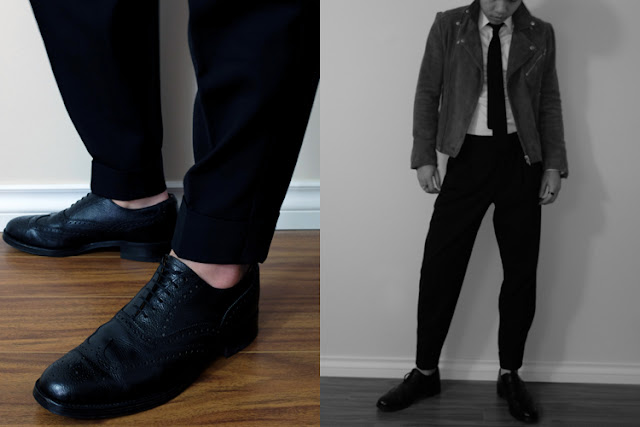
Old tailored trouser from the Gap, cropped 2"; vintage Woodward's brogue wingtip oxford
I went as far as taking this old (like, 14 years old?) generous fitting straight leg double-pleated trouser from the Gap and added two inch cuffs. They have a jogger silhouette to be honest and I thought I ruined them when I asked the tailor to prepare my requested alterations but the results were satisfying after trying them on. They've become my go-to trouser both for business and casual occasions.

I committed a sartorial faux pas by manually cuffing this wool tailored trouser, but somehow... it works.


Zara Studio wool tailored trouser, 2 folds; left, Tretorn Nylite; right: Johnston & Murphy loafers
The aim is to dress down a tailored trouser, and it's something you have to play around with and get a feel for. I first saw this daring style move on the streets of fashion month but also on runways where designers play with leg silhouettes. Looser fabrics and fits with tapered legs work well. I find pleats aesthetically enhance casual folded cuffs and vice versa because they complement one another.

I'm wary of doing this with suit trousers, specifically traditional business suits or anything off the rack without some sort of tailoring done at which point you can have permanent turn-ups put in anyway. Casual suits (e.g., unlined, soft natural shouldered, patch pockets, flat front trouser, etc.) made of lightweight fabrics like linen, cotton, or wool even are preferable for this faux turn-up and dresses them down even more for a nonchalant carefree vibe. Spring wedding anyone?

Some pants are designed to be cuffed and rolled.


Todd Snyder × Gap Infantry cargo pant; vintage Eaton's toe-cap oxford
These olive drab cargos come with a button fastener at the hem that's both functional and a design feature, but mostly a design feature. The crease in the legs I folded myself because I wanted them to have a dressier appeal despite the inherently casual nature of cargo pants as demonstrated by the folded cuff on the left which looks prim and proper compared to the roll on the rough right. All things being equal small details make a difference and can affect how you style the rest of your outfit.


Todd Snyder × Gap Infantry cargo pant; H by Hudson Vale suede camo sneakers
Exact same cargo pants but dressed down further with a pair of suede sneakers. I want to illustrate the spectrum of casual dress where the shoes you wear, or how you style your cuff (if you choose to cuff at all), and other style mods like adding a crease can affect the overall feel of your look, and this is just below the knees!

Of course, I must conclude with a denim cuff. I don't know that I pulled this off as well as I could have because this is a thick cuff, and that's an understatement. Below is the logger/iron worker/proletariat cuff. The reason it's tied to workwear is because it was born from blue collar industries where durable denim or heavy cotton canvas were the fabrics of choice.


Levi's 501, ~4½", vintage Woodward's brogue wingtip oxfords; Levi's 511, ~4½", vintage Eaton's toe-cap oxford
Where I fall short, I think, is the shoes aren't chunky enough to complement the heavy cuff; the toes aren't round and robust enough, and the profile of the oxfords are too slender. Ideally the logger cuff works best with rugged thick-soled work or combat boots, or even a dress boot. I'm not saying an oxford or derby won't work but they need to match the weight of the cuff. Both the shoes and cuffs act as the foundation of the legs so if the footwear falls short the whole look becomes weak and a balance is lost.

The fit of the denim should be considered as well. Levi's 501 is the classic straight leg and demands a heavier sole whereas the 511 is substantially slimmer and actually doesn't look so bad with the brown oxford. Rule of thumb: the wider the leg, the stockier the shoe or boot.


As for length, my 501s have a 30 inch inseam and looks like I'm approaching capri territory (not good), while the 511s are a 32. The two inch difference is noticeably exaggerated by the wider leg of the 501. The 501 logger cuff would look better with a 32 inch inseam, but it's hard to tell unless an entire outfit can be seen. I frequent the logger cuff with my 501s, but it looks awkward here.


It's obvious I'm mad cuffing all my pants but that's because I've incorporated it into my style. Experimenting with what works and what doesn't and seeing inspiration on the streets gave me a lot to play around with. I'd love to see more people cuffing their pants. It's an easy way to express style with a simple fold or roll.